1.0. A bigger, more complete shift.
KBUR joins the field. Career, ground handling, controller standards, radio recovery and a long list of quality-of-life work come together in ProjectATC’s first major milestone.
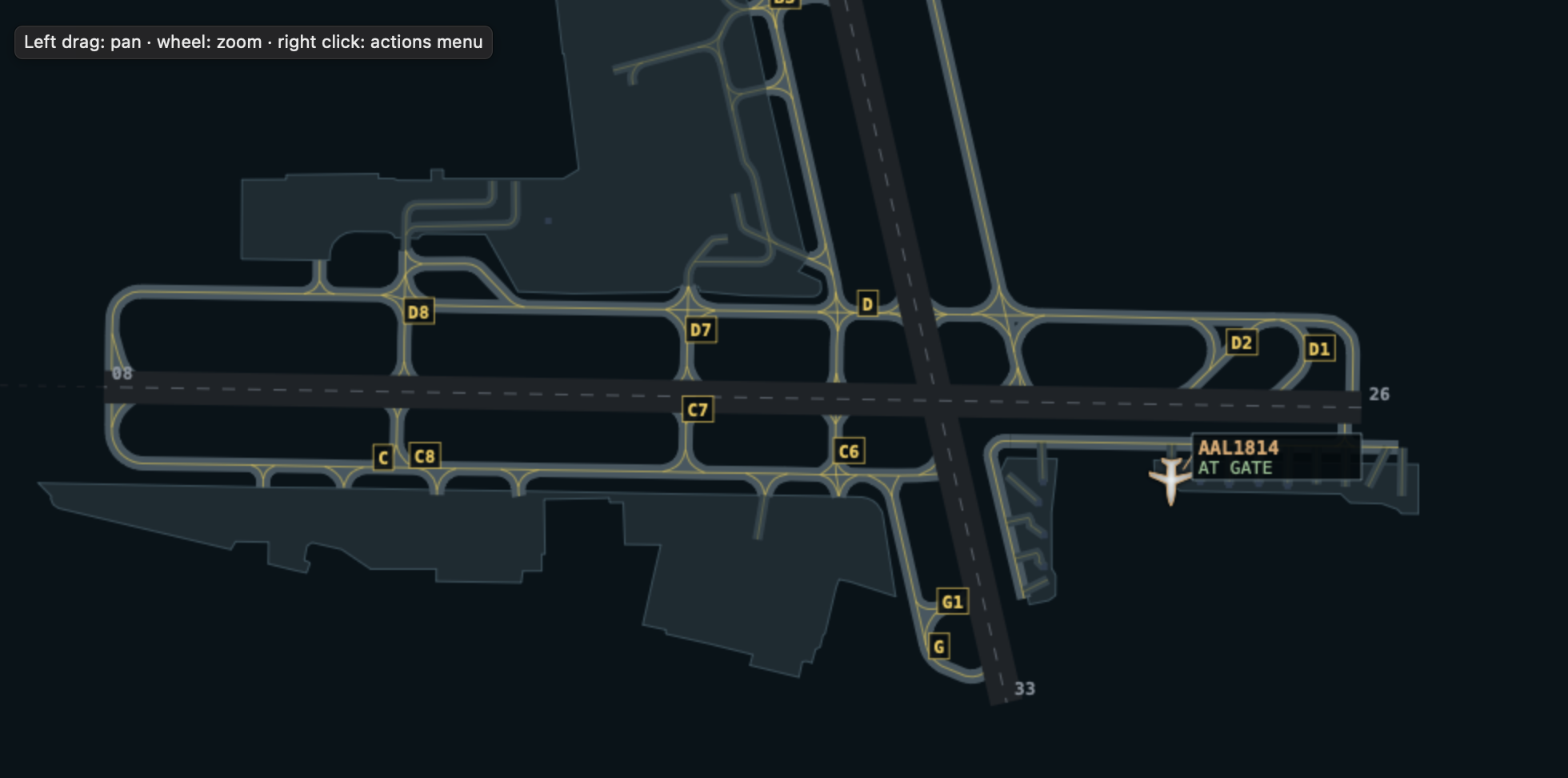
Burbank joins the airport roster
ProjectATC 1.0 adds KBUR (Hollywood Burbank Airport) with two runway configurations and three Career missions. The crossing runways make its traffic picture different from a simple single-runway field: ground movement and runway use need to be considered together. Supplemental taxiway centerlines now connect the mapped network to the runway access points marked in the KBUR review sketch, including access to runway 33.
The map below is a screenshot of the game, not a substitute for an airport diagram. Hot spots identify places that deserve extra attention; they are not themselves holding positions or taxi clearances.
Career is built around airport operations
The Career path now reaches Burbank through ground, tower and checkride missions. The KBUR chapter is identified as BUR in the assignment list. Career objectives continue to use the same traffic and debrief systems as ordinary sessions.
Position standards are available before a shift and while controlling. When a debrief flags an area to improve, it can point back to the relevant standard and Learn material, so the next step is more specific than “try again.”
Ground: route, spacing, movement
Ground movement received a broad pass across taxi routing, pushbacks, runway crossings and traffic conflicts. Aircraft now keep the route prepared after pushback, follow curved pushback paths, preserve more realistic turns and spacing, and wait or use a valid taxiway detour when routes conflict. Aircraft no longer sidestep to pass, and taxi clearances wait for traffic already occupying a conflicting route.
Controllers can amend a taxi route while an aircraft is moving. A runway crossing remains a distinct clearance; aircraft with crossing approval continue through the runway before yielding. Arrivals keep priority until clear, and runway exits and stands are kept clear for arriving and departing aircraft.
This flow explains the general control sequence. It does not certify an airport route; airport data and published charts remain the source for specific taxiway geometry.
Airport-specific work in 1.0 includes custom pushback, taxi-in and runway-exit routes at KSFO, corrected runway geometry at KMDW, and taxi-in routes at KBOI. The selected departure runway is checked against aircraft performance, and takeoff and line-up follow the same paved runway-entry path.
A better way to recover a radio call
Received radio messages can be replayed using the aircraft’s assigned voice. If a call was missed, Say Again requests a repeat without a score penalty. Pilot voices also use steadier speaking rates from one aircraft to another, and callsigns retain the same assigned voice throughout a session.
Clearances and procedures follow the operation
Approach clearances are tied to the selected published procedure. IFR go-arounds return to Approach and use the published missed-approach route; VFR pattern traffic remains with Tower. Radar vectoring floors follow charted MVA sectors, and compatible published STARs can be issued with descend-via clearances. After passing an approach fix, arrivals no longer enter an uncommanded circle.
On the ground, takeoff, line-up, taxi and runway-exit paths share the same runway-entry geometry. Departures also avoid runways that are too short for their aircraft category.
More information where the controller needs it
Focus tools help set a measurable objective for a session, while aircraft strips can hold private notes for the current session. The frequency panel can remain open while you work, and Daily Approach calls correspond to traffic that is actually present.
The debrief connects session findings with position standards and relevant Learn guides. Career and Daily goals have also been checked against their available time. Runway selection is checked against aircraft category, traffic already taxiing gets priority at merges, and waiting aircraft yield to moving traffic.
A more consistent workspace
Setup, mode selection and debrief share a more consistent interface. Keyboard focus, browser zoom, contrast and reduced-motion behavior have been improved, and core flows now include checks in Firefox and WebKit. Ground turns move more smoothly at low speed, and aircraft spacing is handled more consistently at merges and runway queues. The public leaderboard remains viewable without signing in.
A free account is required to start
Creating a free account or signing in is now required before starting a session. No payment card is needed for a free account. The account prompt appears before the game opens; the public leaderboard remains available to browse without signing in.
The 1.0 promise
Version 1.0 is a milestone, not a claim that every airport map is perfect. Airport-specific taxiways and hot spots must be read carefully: a hot spot is not a hold-short point, and a map line should not be treated as a clearance. At KBUR, supplemental taxiway centerlines complete the runway links shown in the reviewed map sketch; the same authored-geometry format can extend other OSM-based airports without adding airport-specific routing rules.
Use the in-game route and clearance as the operational instruction. When reporting a map or routing issue, include the airport, runway configuration, aircraft stand, clearance, and a screenshot showing the aircraft and route.